
Origin of 18 Footers
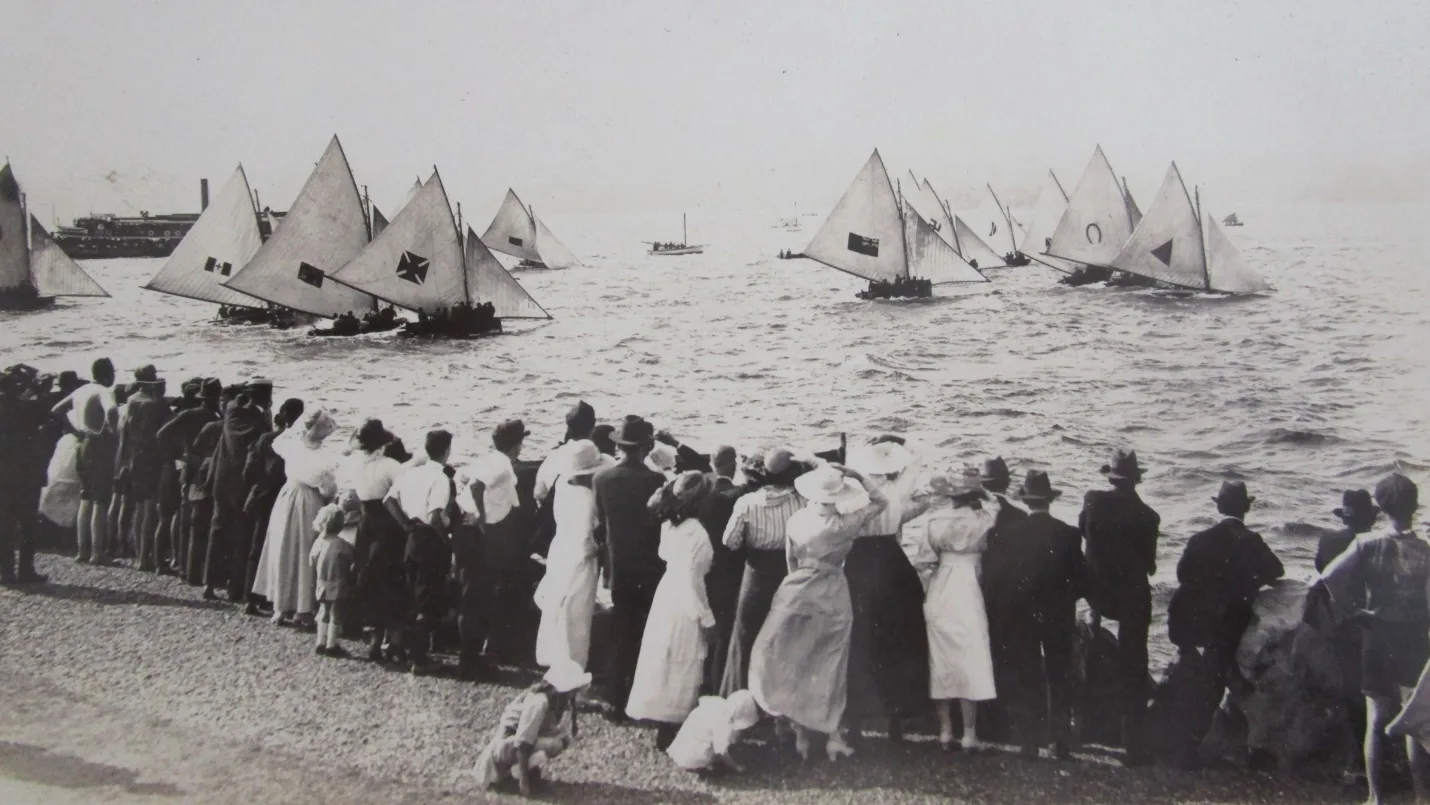
The 1890s sailing environment was the pinnacle of conservatism. Then along came this upstart called Mark Foy. He had made his fortune in retailing and had one of the biggest department stores in Sydney. He wanted to upend tradition and do things like have colours on sails so spectators could easily identify boats.
He did not ask the sailing establishment’s permission. In August 1891 he put three hundred pounds of his own money into a new club, leased rooms in Oxford Street and wrote the rules himself. Boats would carry coloured devices on their sails, so that a stranger could tell them apart against a printed card. The course would be a short triangle, no more than three and a half miles, so the whole of a race could be watched from one spot on shore. And the handicap would be given at the start, so that the first boat home is the winner and everybody watching knows it.
At first they raced all lengths of open boat from 6 footers up to 24 footers. Gradually the 18-footers came to dominate. Instead of complex rules and formulas the standing joke was there were only two rules. The boats had to be 18 feet long, and the race started at a quarter to three.
The press was at first equally unkind. The club's official opening, on Saturday 17 October 1891, was spoiled by a high westerly that forced the planned evolutions to be abandoned, and the Sydney Morning Herald of the following Monday thought the afternoon “anything but a success”. Of the sails it wrote:
“Eight boats … turned up with their usually snow-white sails disfigured by coloured designs, some painted, others with coloured cloths, and, if the opinion expressed on Saturday are taken as criterion, these disfigurements of the sails will certainly not become popular.”
The public however loved it. In fact a week later, reporting on the first race under Mark Foy rules, the SMH changed some of its tone, reporting on the innovation of the handicapped start
“there is not the slightest doubt but that it should prove a success … exciting finishes are the result”.
The gentlemen of the sailing establishment leaned back, took a puff on their cigars and downed another port. Six weeks later, with the crowds on Clark Island getting larger every Saturday, they had stopped leaning back.
On 7 December 1891 the committee of the National Regatta, which ran Sydney’s Anniversary Day races, carried a resolution:
“That no yacht or sailing boat shall carry on its sail any distinguishing mark whatever other than that provided in rule 2 (distinguishing number).”
Numbers, and nothing else. Note what it does not say. It does not name the Squadron, and it does not ban anybody: a Squadron boat could have turned up and started under plain canvas. What made it bite was that the devices were dyed, painted and sewn into the cloth, so taking them off meant ruining the sails, and no notice had been given. And the objections recorded at the time were not about how the sails looked, whatever has been said since. They were about betting, sweeps and prize money.
Foy answered in public, at a meeting at Carrington Hall on 19 December. The colours, he said, were there
“to enable the public to participate in the pleasure to be derived from first-class boat-racing by enabling those who could not be expected to know the boats to be able to follow them all over the course.”
The committee would not move. So the Squadron ran a regatta of its own, on the same day, off Clark Island on 26 January 1892: sixteen events of sailing and rowing, got up in about three weeks on subscriptions of a few shillings a head. The Daily Telegraph had predicted a flop, and reported instead that “as far as it went it was in itself a highly successful gathering”. It also put its finger on what the fight had really been about, calling it “a contest between colors and numbers”. The establishment wanted boats you had to look up. The Squadron wanted boats you could see.
By the 1920s several over-full ferries would follow the boats around the harbour. Thousands would line the harbour to watch the races. The skippers were the rock stars of sport in Sydney.
But there was another reason for the popularity. Aboard the ferries, illegal bookies would take bets on the races. Who finished first. Who would capsize. Who would be first around the next mark. Of course those good citizens who thought gambling was the work of the devil, were horrified and demanded the police do something.
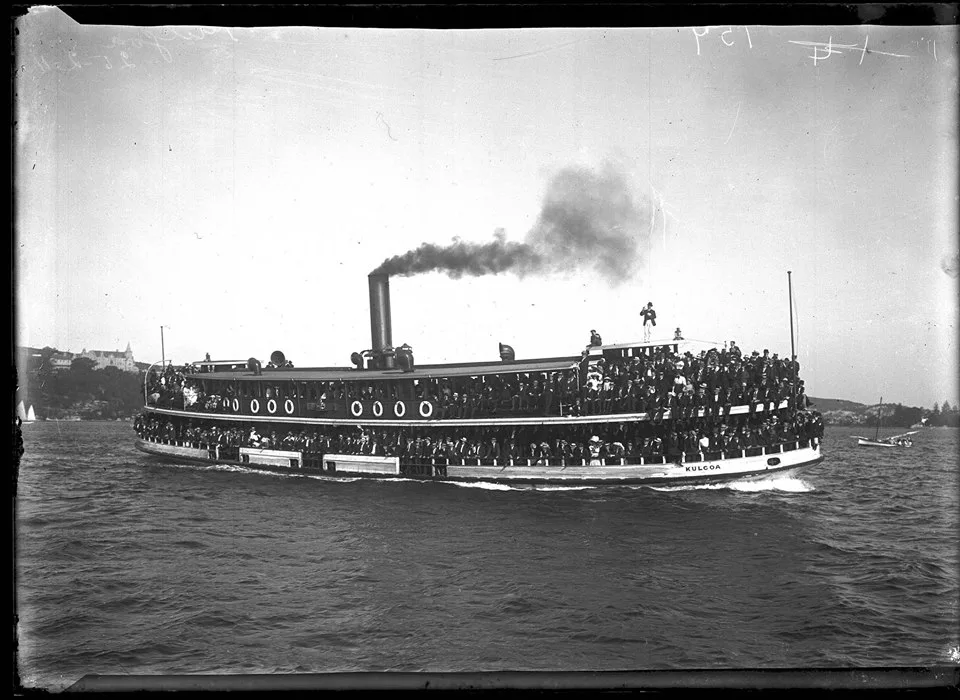
Occasionally the police boarded a ferry and found not a trace of gambling. Many of these raids took some time to actually take place. Ferries are tricky things to board, particularly when they are weaving down the harbour. Nevertheless, when the police finally got on board there was not a sign any gambling was going on.
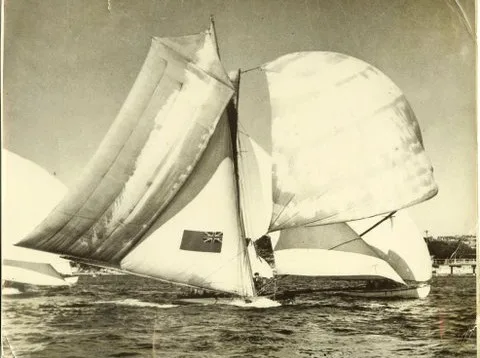
The typical 18-footer of the big boat years carried a crew of about ten to thirteen, plus a boy whose job was to bail. Yes, that is a dozen people in 18 feet. You had to carry so many people as moving ballast to balance the enormous rigs.
Every conceivable type of sail was deployed, and a few that were inconceivable. Water sails hung under the bow sprit (called a bumpkin on 18-footers). Ringtails that hoist outside the mainsail when running downwind. Width narrowed from 8 foot beam down to 6 foot.
The boats we race today from Sydney Flying Squadron are replicas of those boats. We have made some changes. All boats use modern sail material rather than cotton sails. Masts are generally aluminium rather than timber. Hulls are moulded plywood rather than planked. We do have one boat, Britannia, that uses timber spars and a carvel planked hull.
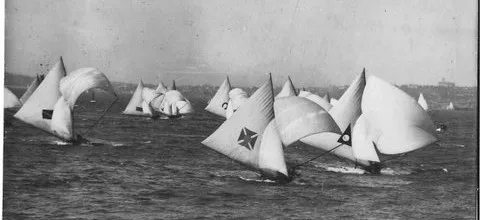
The boats still provide the same thrill they did in 1920 and require a set of skills most modern sailors would never learn. The fleet and our sailors keep alive knowledge and tradition that would otherwise disappear.
The club also has an ongoing history function and has collected trophies, documents, and memorabilia of that time. We continue to collect material and ensure that the experiences and achievements of those intrepid sailors will never be forgotten.