
Mark Foy
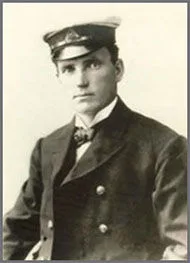 Mark Foy founded the Sydney Flying Squadron in August 1891 and was its first commodore. Fifty five years later, when the club opened its fifty sixth season, the Sydney Morning Herald still called him its founder and life patron. He was a Sydney retailer, an early motorist, a catamaran owner, and the builder of the Hydro Majestic in the Blue Mountains. What he gave this club were three rules, and every one of them was written for the people watching from the shore.
Who cares who wins when no one knows?
That line is Foy's own, from his pamphlet Sailing. In the 1890s you could watch a sailing race from a steamer, lose the boats among the harbour traffic, and then wait for Monday's paper to find out who had won. Foy thought that was no sport at all, and he said so in print.
When the club was announced in the Sydney papers on 13 August 1891, the problem came before the proposal. The Evening News reported that the promoters wanted "to more thoroughly popularise sailing", because at present "after the vessels have once started all interest is gone, from the fact that so few persons are enabled to witness the racing from start to finish and then only from a steamer, and often under considerable inconvenience, especially for ladies".
The first people named as shut out of the sport were women. That is the founding grievance, in the founding notice.
The club was formed at Rainford's Cambridge Club Hotel in August 1891. W. J. Richardson was elected the first honorary secretary and a committee of seven appointed, Foy among them. He gave three hundred pounds towards the formation of the club and leased its rooms in Oxford Street. Nineteen boats had already declared.
The three rules, and what each one was for
Every rule Foy wrote answers the same question. Can a stranger on the shore follow this race?
Coloured devices on the sails. Every alternate cloth dyed a bright colour, so that the boats "may be readily known on reference to the racing cards". The colours were not decoration. The club printed a card, so that somebody who knew none of the boats could read the fleet like a legend.
A short triangular course. Not more than three and a half miles, laid so that "the whole of which can be viewed from some prominent spot on shore", with two heats and a final in a single afternoon.
The handicap given at the start. Slower boats away first, so that the first boat home is the winner and everybody watching knows it at once.
Two further rules show how carefully the thing was designed. The starter had to lay the course so that the boats finished before the wind with everything set, which put the fleet across the line at full speed under full sail. And no boat was allowed to fly its colours except while racing, so that a coloured sail on the harbour meant a race was on and nothing else.
Where the handicap start really comes from
It is Foy's system, and it was running before this club existed. In January 1891 the Evening News reported that in Port Jackson Sailing Club races for the Mark Foy medals "the boats will receive their handicap at the start, and Mr. Foy has arranged a complete system whereby this method can be carried out successfully", and added that "Mr. Foy's system will be in use at the starting of the races at the National Regatta". The Squadron, founded seven months later, was the club built around it. By 1900 Dixon Kemp's Manual of Yacht and Boat Sailing was describing handicaps at the start as the Sydney system.
It was not a world first. The Royal Yacht Squadron at Cowes had tried staggered starts in the 1830s and gone back to starting together by 1841. What Foy did was make the idea work, and get Sydney to adopt it. Sailors still call it a Mark Foy start.
The first race, 24 October 1891
The club's official opening, on Saturday 17 October 1891, was a failure. A high westerly put paid to the planned evolutions, and the Sydney Morning Herald thought the afternoon "anything but a success". Of the sails it wrote that eight boats "turned up with their usually snow-white sails disfigured by coloured designs, some painted, others with coloured cloths, and if the opinions expressed on Saturday are taken as criterion, the designs of the sails will certainly not become popular".
The paper was wrong about that, and it took a week to change its mind.
The Squadron's first race was sailed the following Saturday, 24 October 1891, from Clark Island, in heats, for prizes of twenty pounds, seven pounds and three pounds. Foy sailed his own boat Kananook and won the second heat. In the final, Chris Webb, sailing the 24 footer Mantura off scratch and therefore starting last, ran Kananook down in the closing lengths. The Herald printed the finishing times: Mantura 5h 55m 50s, Kananook 5h 55m 51s, Massilia 5h 55m 52s.
The club's first race was won by one second, by the boat that had started last, and everybody on the shore knew who had won the moment it happened. That is exactly what the handicap start was built to produce, and it produced it on the first day.
The crowd came too. "A very large number of people were conveyed to Clark island", the Daily Telegraph reported, and "one steamer which could not get near enough to the shore to land her passengers, carried several hundred folk about the harbor all the afternoon, following the several heats". Within a fortnight the club had a brass band playing on the island. Before the season was out a race was postponed because rain had made the island impossible to land on and the spectators could not get ashore.
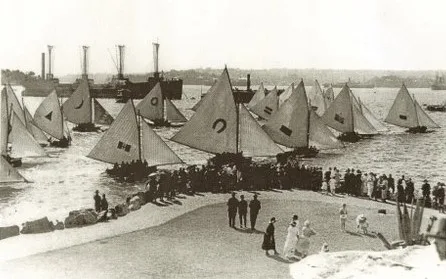
The whole design in one photograph: large devices on the sails, the boats close in, and the public on the shore. From the club's own collection.
The row over the colours
The club is often said to have been founded because Foy was banned from the Anniversary Regatta, which was Sydney's Australia Day regatta. The order of events is the other way round, and "banned" is not quite the right word either.
The Squadron was instituted in August 1891 and had been racing since October. On 7 December 1891 the committee of the National Regatta, which ran the Anniversary Day event, resolved "That no yacht or sailing boat shall carry on its sail any distinguishing mark whatever other than that provided in rule 2", meaning the regatta's own number. The rule applied to every boat in the regatta, not only to the Squadron's, and a Squadron boat could have started under plain canvas.
What made it bite was cost and notice. The devices were dyed, painted or sewn into the cloth, so taking them off meant ruining the sails, and the owners had been given no warning. The objections recorded at the time were not about how the sails looked. They were about betting, sweeps and money prizes. Nor were the objectors the grand yacht clubs. The men who spoke for the rule came from the Amateur, Port Jackson, East Sydney and Balmain sailing clubs, which were open boat clubs like the Squadron itself.
Foy answered in public. At a meeting at Carrington Hall on 19 December 1891 he said the colours were there "to enable the public to participate in the pleasure to be derived from first-class boat-racing by enabling those who could not be expected to know the boats to be able to follow them all over the course", and he denied that the club had been started to promote betting, adding that he had said as much when it was founded.
The regatta committee would not move. On 4 January 1892 a second public meeting, chaired by the Squadron's secretary A. Krone, resolved to run a rival event on the same day. The Australian Anniversary Regatta was sailed off Clark Island on 26 January 1892: sixteen events of sailing and rowing, put together in about three weeks and paid for by subscription, a few shillings a head collected on printed cards. The Daily Telegraph had predicted failure and reported instead that "as far as it went it was in itself a highly successful gathering". It also named what the fight had really been about, calling it "a contest between colors and numbers". The establishment wanted boats identified by a number you had to look up. The Squadron wanted them identified on sight.
Foy sailed in that regatta himself, in Kannanook. In February 1892 the club presented him with an illuminated address, painted with four of its boats, which is now in the collection of the Australian National Maritime Museum.
What the folklore says
Club folklore says that Foy financed the rival regatta himself and donated the whole of the prize money, and that he engaged a lorry to parade the streets with a calico sign. Neither detail has turned up in the newspapers of the day, which show him as one expected subscriber of fifty pounds among others inside a general subscription, and say nothing about a lorry. That does not make the stories wrong. A great deal of what a club knows about itself never reached print, and if anyone holds a cutting, a minute book or a family account that carries either of them, we would like to see it. What the papers do record is that Foy guaranteed the Squadron's own prize money year after year, and that in the 1903 to 1904 season he handed the club a hundred pounds simply to start the season with.
Flying Fish
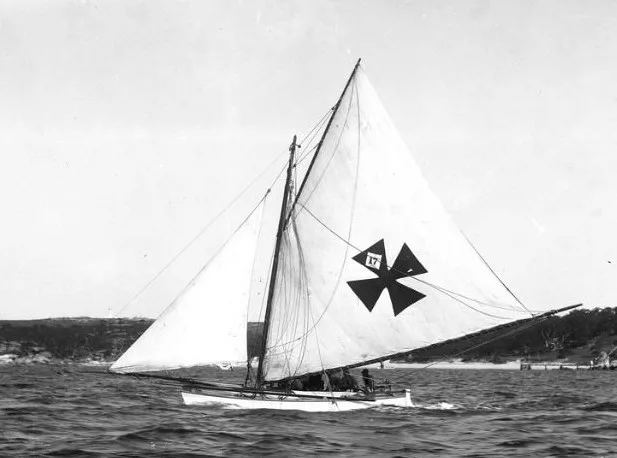
Flying Fish, Foy's catamaran, carrying her sail device. From the club's own collection.
In 1894 Foy had the Double Bay boatbuilder Messenger build him a double hulled boat, Flying Fish, of twenty four feet, cut down to twenty two in 1897 so that she could enter the intercolonial twenty two footer race. She raced through the 1890s and was the best known catamaran on Sydney Harbour in her day.
She was not the first catamaran in Australia, and we should not say she was. A twenty three foot boat named Gemini, described at the time as "on the catamaran principle", was racing with the Sydney Amateur Sailing Club in February 1881, thirteen years earlier and on this same harbour. Foy did not build Flying Fish either. He ordered her, and he sailed her.
The rest of his life
Mark Foy was born at Bendigo on 15 February 1865, the third son of an Irish draper who had come out to Victoria in 1858. In 1885, aged twenty, he and his elder brother Francis opened a drapery in Oxford Street, Sydney, under their late father's name: Mark Foy's. Francis was the driving force of the firm. Mark stepped back from it in the 1900s and gave his time to sailing, to motoring and to the Blue Mountains.
In July 1904 he opened a hydropathic resort on the clifftop at Medlow Bath, which the papers of the day called the Medlow Bath Hydro. He remarketed it a few years later as the Hydro Majestic, the name it still carries.
He never left the Squadron. He was its first commodore and held the office for decades. In December 1924 he was still underwriting regattas and arguing that New South Wales should run a whole aquatic week over the Christmas holidays. In September 1946, as the club began its fifty sixth season, the Herald called him its founder and life patron. He died in St Vincent's Hospital on 15 November 1950, aged eighty five, two days after a fall in the garden of his cottage at Bayview. At its next race the Squadron's boats flew black mourning ribbons.
The club's restaurant is named Foys, after the store. The store was named after his father.
Where this page comes from
This page is built on the newspapers of the day, read on Trove. The Evening News and the Daily Telegraph of 13 August 1891 announce the club and print its rules. The Sydney Morning Herald of 19 and 26 October 1891 covers the opening and the first race. The Evening News of 12 January 1891 records the handicap start in use before the club existed, and the same paper of 8 December 1891 carries the regatta committee's resolution. The Australian Star of 19 December 1891 reports Foy's own speech at length. The Daily Telegraph of 27 January 1892 reports the rival regatta. The Australian Town and Country Journal of 9 February 1901 looks back over the club's first ten years.
Foy's own words come from his pamphlet Sailing, quoted in C. de Montfort's 2013 study of open boat racing in 1890s Sydney. The pamphlet itself has not been found, and the club would like to hear from anyone who holds a copy.
One published source disagrees with this page. The Australian Dictionary of Biography dates the club's founding to 1890. The contemporary record does not support that year, and we follow the record.