
Myra Too
Replica of Bill Barnett's 1950 skiff that swept the state, national and world titles in 1951, winning the J.J. Giltinan Trophy for the Sydney Flying Squadron for the first time. The replica was built by Barnett's former apprentice Bob McLeod to plans by David Payne and launched in 2013.
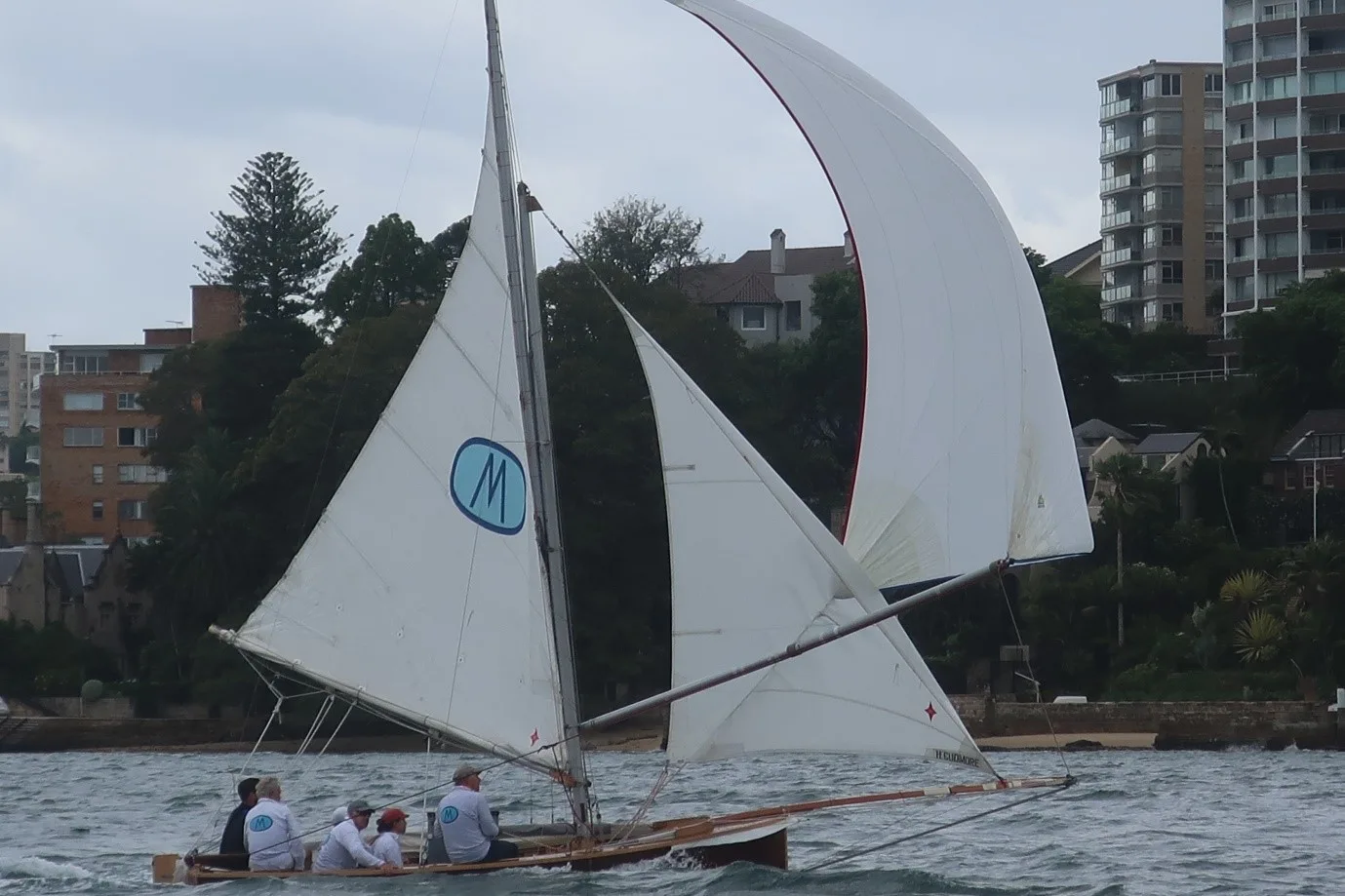
The boat
- Original launched
- 1950
- Replica launched
- 2013
- Original builders
- Bill Barnett
- Original skippers
- Bill Barnett
- Former skippers
- not recorded
- Notable honours
- Won the state, national and world titles in 1951, taking the J.J. Giltinan Trophy for the Sydney Flying Squadron for the first time by winning all three heats.
- Dedication
- To Bill Barnett O.A.M. and his J.J. Giltinan champion crew 1950-51
- Jumpers
- White with emblem
- Beam
- 6ft (1829 mm)
- Length
- 18 feet
Status
- Status
- not recorded, awaiting the sailing committee
- Owner
- not recorded, awaiting the sailing committee
- Estimated annual cost
- not recorded, awaiting the sailing committee
The story
For over one hundred years Sydney Harbour has played host to the spectacular sport of 18-footer sailing. In the 1950s the sport reached a new era. Developments in design moved fast, and the guard was changing with the deaths in quick succession of two prominent patrons, Mark Foy and J.J. Giltinan. It was at the start of this decade that Bill Barnett built the 18-footer Myra Too, and in a historic era for sailing Barnett made history, taking out the state, national and world titles in 1951.
Barnett built the first Myra and, in joint ownership with his brother George, won the 1948-49 national championship. He was not placed in the following season, which was dominated by Lance Watts' Culex III, but returned in force for the 1950-51 competition with the newly built Myra Too. Despite winning the state championship the week before, Myra Too faced strong contenders for the Interstate Championship when it was held in Sydney in January 1951. The Queensland team Jenny IV (Norman Wright) and the reigning champion Culex III (Lance Watts) both beat Myra Too in the first heat before Barnett fought back to win the second and third heats and claim the title.
During the 1951 world titles, New Zealander Jack Logan was well placed to present a strong challenge in his new yacht Taura, having performed well during the selection trials. However, Myra Too blew all of her opponents out of the water, winning all three heats of the competition with astonishing ease and taking the first by a convincing margin of 4 minutes 24 seconds. In winning the championship, Barnett netted the JJ Giltinan Trophy for the Sydney Flying Squadron for the first time, and his vessel's exceptional performance prompted Logan to later remark “Myra Too was in a class by herself”.
Barnett was one of Sydney's finest wooden boat builders, and in the design of Myra Too he created something particularly special, with the vessel exceptionally suited to the conditions of Sydney Harbour. Myra Too had a powerful Marconi rigged big sail and showed good all-round speed in any conditions. Barnett had made the boat a little finer than most 18s and with a bit more flare on the topsides forward, a straight entry at the waterline, and planking rounded into the stern to give the hull a streamlined shape overall. Myra Too also boasted a light duralumin fin, which was 55 pounds lighter than the conventional heavy steel fin, and a new bent back “banana” mast similar to those emerging in the 30 Square Metre class.
In addition to her innovative design, Myra Too was helped to glory in 1951 by the capabilities of her crew: Barnett at the helm, forward hand Sid Ferguson, sheet hand Fred Evennet, jib hand Andy Costyn, swinger Jack Davies and bailer boy Brian Stewart. Stewart has said of his time sailing with Barnett: “I still think he was the best open boat skipper of all time and if the rest of the boys were still with us they would agree.” As quickly as Myra Too had taken the Sydney sailing scene by storm, she disappeared into obscurity. Barnett went on to race the following year in Myra III, and Myra Too was sold several times, passing through different names, first Merle, then Minnawatta Too. The vessel did not return to the same heights of glory and has since disappeared from the historical record.
In 2012 the Australian Open Skiff Trust engaged Bill Barnett's former apprentice Bob McLeod to build a replica of Myra Too, with Australian National Maritime Museum curator and Alan Payne's nephew David Payne drawing up the designs. Due to the fire that tore through Barnett's boatshed in 1971, the original plans and half models for Myra Too were destroyed, leaving McLeod and Payne to work from a combination of skill, instinct, memories and old photos. Using Payne's plans and a wooden half-model based on those lines, McLeod first created a mould from which to begin the build. He used silver ash for the keel and ribs, placing the ribs over pine stringers. Three thin layers or skins were then added to complete the hull, the second of Klinkii plywood and the first and third of historic Queensland red cedar believed to be around 400 to 600 years old, polished to an eye-catching deep red hue. In another nod to history, McLeod incorporated wood from another champion vessel built by Billy Barnett, Gretel II (designed by David Payne's uncle Alan Payne), into his detailed design.
As the intention is to sail the boat for several seasons, the replica is slightly stronger and heavier than the 1950 original, which Barnett built light, and it has been affectionately nicknamed “Myra Too-and-a-bit”. The glue and varnish used in building the replica were kindly donated by Les Baker of Norglass, with Goldspar donating the spars, along with the many volunteers who passed through McLeod's custom-built shed during the build. In March 2013 original crew member Brian Stewart, now living in Queensland, came across mention of the project online and reconnected with the Sydney sailing community and his old skipper Bill. In May 2013 a tribute day was held at the Sydney Amateur Sailing Club to celebrate Billy Barnett and his achievements as a sailor and shipwright, as well as raise funds for the completion of Myra Too.
You can sail this boat. Try sailing three times before joining; we provide the training. Start here.